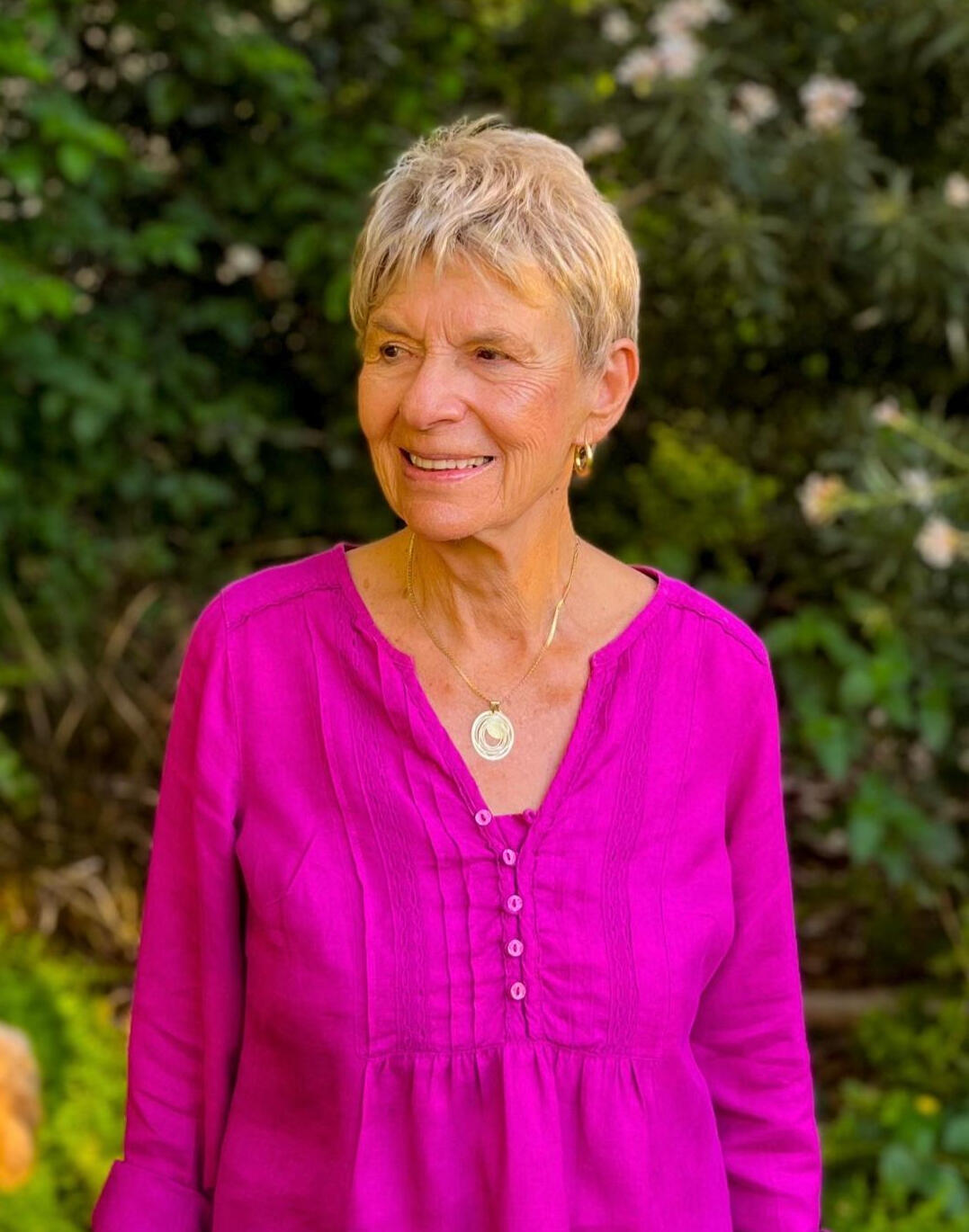
RICKY FRIESEM
Pen Name: Ricky Rapoport Friesem
Journalist, filmmaker, poet, dreamer, doer, wife, mother, grandmother, great-grandmother…and the order varies daily.
Essays and Short Stories
WHAT’S IN A NAME?2018 Tiferet Magazine Writing Contest Winner
MY BAPTISMAn Essay/Memoir
JUST THE JASMINEFirst published in JewishFiction.net
Just the Jasmine
First published in Jewish Fiction.com
The braying woke her. The same loud, rasping noise had greeted her every morning since her arrival in Tel Aviv two weeks earlier. By now she knew the unfamiliar sound was a donkey’s braying. That first morning in her uncle and aunt’s apartment, she had been convinced it was someone pumping water, or maybe even oil, right under her bedroom window. Why not? Everything was going to be different here in Eretz Yisrael, Sarah smiled to herself. Here, anything was possible.With a sigh, she snuggled deeper into the canvas-covered straw mattress. It had taken some getting used to. Back home in Kobryn, her bed was soft, the fine cotton sheets ironed smooth by the maid who helped her mother run the house. But this bed, rough and lumpy though it was, had already begun to conform to the contours of her body. She had struggled against the newness at first, and then, given in. Now they were one. Its hollows and her curves. Give and take. Livnot v’lihibanot ba. To build the land and be built by her. Wasn’t that what the pioneer’s song said?Sarah stretched out full length and closed her eyes. The window over her bed was open, letting in a soft breeze with just a hint of the sea. The thought of the sea filled her with joy. Joy that she, Sarah Katz, from frozen White Russia, actually lived within five minutes of that incredibly blue and warm wonder. She let the breeze caress her face and lift her thin cotton nightgown ever so slightly, like a sail catching a hint of wind. In Kobryn there’s probably still snow on the ground, she was thinking, suffused with the sheer pleasure of the Mediterranean morning.“Sarah, it’s late. Avram’s waiting,” her Aunt Dora’s commanding voice rang out, pronouncing her name with the doctrinaire emphasis on the last syllable.Avram. Her body convulsed as it had seven hours earlier when she had felt her uncle’s hand grope towards her under the summer coverlet. Instinctively, her knees had snapped to her chest, as she drew herself into the fetal position, as far as possible away from the side of the bed where Avram had seated himself. Had it really happened? Avram? Uncle Avram? The Zionist ideologue, the local hero whose eagerly-awaited letters from British-mandated Palestine were eagerly passed from hand to hand back in Kobryn? Sarah shuddered. She would never be able to tell anyone. No one would believe her.Avram was sitting at his usual place at the head of the table, absorbed in dipping a tea bag up and down, into a tall glass of hot water. He looked up as she walked in. His Charlie Chaplin moustache was fringed with white from the labeneh he had just eaten.He looks ridiculous, Sarah thought with satisfaction. Avram intercepted her glance with a bold stare.“Boker tov. Good Morning, Sarah,” he called out. “What do you think, you’re still in Kobryn?
Here we start early. Remember? Yalla. We leave in five minutes.”Sarah headed for the kitchen to make a sandwich for her lunch at the dairy which Avram managed and where he had found her a job. The very sight of him now was enough to make her want to throw up. She planned to sweep right past him, face averted. But in the split second it took to execute her decision, Sarah found herself nodding to her uncle.By the time she’d reached the shelter of the kitchen, Sarah knew that she had to move out of the apartment immediately. She wasn’t made for this game. She should have confronted her uncle at the breakfast table, stopped this Jekyll and Hyde charade. What did he think? That he could pretend it never happened? And here she was, nodding to him politely.That very afternoon at the dairy, she approached the good-looking young supervisor who had been flirting with her from the moment they had been introduced. “Listen, Moshe, maybe you can help me. I have a problem.”“Sure, sure,” he responded eagerly, not waiting for her to continue.“Moshe, I’ve got to move. Living with my aunt and uncle isn’t working out. It’s just too crowded. Maybe you know of someone with a room for rent?”“Give me a little time,” he replied. “I’m sure I’ll come up with something.”And he did, the very next day. “It couldn’t be better, with Uncle Max dying and all!” Moshe exclaimed, as they set out after work. He caught himself and added hastily. “I didn’t mean it the way it sounds. You know what I mean. Aunt Fruma must be very lonely. It’s just perfect.”Perfect it isn’t, Sarah thought. Truth was she was scared. Everything was happening too fast.
Yesterday she had been relieved. Today, striding beside this virtual stranger, she was in turmoil. What do I actually know about him? That he’s soft-spoken and has a nice smile?She had succumbed so quickly to his purposefulness. And now, as they headed down the shaded sidewalk of Rothschild Boulevard, she felt she was being dragged into this stranger’s life. She pictured herself as a puppet on a string, dangling from Moshe’s broad, suntanned hands. For an instant, the vision of her uncle’s pale freckled hands rose before her. She shuddered and drew closer to Moshe. She let herself imagine Moshe’s muscled arms encircling her. Those bronzed hands cupping her breasts. And she wanted him to. And yet, at the very same time, a chill of revulsion ran up her spine. What’s happening to me? she wondered.The enormous flame trees on Rothschild Boulevard were in full bloom. In the short time she had lived in Tel Aviv, Sarah had come to love those flamboyant trees almost as much as the white birches that were an inseparable part of the landscape of her childhood. She had discovered the tree-lined boulevard on one of her first outings, drawn there by an overwhelming fragrance that she later discovered was the scent of the jasmine lining the paths. So unlike anything she had seen in Kobryn. And so like everything she had imagined Tel Aviv to be.The calm that came with late afternoon had settled over the boulevard. The residents, who had taken shelter indoors from the damp, summer heat, now ventured forth to enjoy the cool breeze coming in from the sea. The street was quiet, the voices muted, as if the nervous energy of daytime Tel Aviv had dissipated with the fading light. Moshe slowed his brisk pace, falling into step with the languorous strollers. They walked in silence, Moshe seemingly totally absorbed in the task of guiding her to their destination.Ninety-two Rothschild Boulevard stood on a corner. A three-storey apartment building. Flat roof. Smooth white stucco finish. Long balconies stretching the entire length of each floor, a double row of tubular metal railings their only adornment. The angle where the east and north side of the building met had been rendered as a curve. The entrance was unassuming, slightly recessed and shaded by a jutting rectangle of concrete.“This house was designed by Bernstein,” Moshe said proudly. “You know — one of the Bauhaus architects from Berlin?” he added, reacting to Sarah’s blank stare.It looks like Dora and Avram’s new icebox, Sarah thought, and responded with a noncommittal, “Oh.”She followed Moshe meekly up the spotless terrazzo stairs. The stairwell was bathed by the grey-blue evening light, filtering in through two parallel rows of glass bricks which ran vertically down the front of the building. There was just enough light for Sarah to make out that this was a more luxurious apartment house than the one where Avram and Dora lived.For the first time since Moshe had mentioned his Aunt Fruma, Sarah allowed herself to think about her prospective landlady. I hope she’s not as serious as her name sounds, she thought, nervously smoothing her skirt and wind-blown hair. And, please, let there be shades on the light bulbs and a rug on the floor. Moshe rang the buzzer.“Who is it?” a breathless voice called out.“It’s me, Moshe, Tante Fruma.”“Oh, Moshe, eyn minut. Ich kum. Ich kum. One minute, I’m coming.”The tap-tap of rapid footsteps. A lock turned twice, and the door opened. The light from the apartment spilled into the hallway. A small, fine-featured woman, with a head of thick, gray hair pulled back loosely into a bun, looked up at her visitors.“I was expecting you earlier,” she said reproachfully.“I’m sorry, Tante,” Moshe apologized. “It was such a lovely, cool evening, we took our time.
Tante, this is Sarah.”“Another Kobryner,” Fruma responded, ignoring Sarah’s outstretched hand and giving her a warm hug instead. “We’re almost landsmen. I’m from Malch.Sarah felt a surge of relief. Silently she reproached Moshe for not telling her that his family hailed from the same part of White Russia.“We’ll have plenty of time to talk about the old country, won’t we, Sarahle?” The elderly woman leaned towards Sarah conspiratorially and steered her towards a small, white-painted table set for three.Sarah looked up at Moshe, raising her eyebrows in a wordless question. He shrugged in a gesture of helplessness and motioned for her to sit.“I’ll be right back,” chirped Aunt Fruma, exiting towards what presumably was the kitchen. The bird-like tap of her shoes echoed down the hallway.Fruma’s chatter had momentarily lightened Sarah’s mood. Now the heaviness settled again. The apartment, though much larger than Dora and Avram’s, reflected the same commitment to a rigid asceticism. Spotlessly clean and bare. No rugs. Unadorned light bulbs hanging from the ceiling. An uninviting, straight-backed, olive-green sofa against one whitewashed living room wall.Next to the sofa was a little alcove in which hung two large oval-framed sepia photographs, side by side. For a brief moment, Sarah thought that they were her own Bobeh Sheindel and Zaide Mordechai, so similar where they to the portraits of her grandparents that hung in the dining room in Kobryn. Now, seated across from the alcove, she could see that Aunt Fruma’s ancestors bore no real resemblance to her own. It was the soft blur of sepia and the stolid stare imposed by the studio photographer that had succeeded in creating what at first looked like a matching set of ancestors. As did her longing.The only other adornment on the wide expanse of wall was an olivewood-framed certificate.
Sarah got up to examine it more closely. It was in Russian. Boris Zaretzky had graduated as an engineer from the Technical Institute in Minsk.“Your uncle?” Sarah asked. Moshe nodded. The certificate confirmed the conclusions she had already drawn. The spare, unadorned harshness of this interior was the political statement of an East European intellectual. Notwithstanding the alcove of homage to their shtetl past, the Zaretzkys, like all the landsmen whom Sarah had met in Palestine, were determined to wipe clean the slate of their bourgeois past. Aunt Fruma’s Spartan lifestyle was not prompted by poverty. Poor people didn’t live on Rothschild Boulevard, and they didn’t have telephones. Sarah’s eyes had been drawn to the black apparatus that stood on a spindly legged table under Boris Zaretzky’s graduation certificate. Next to cars, telephones were the most coveted status symbol in this brave new world. And almost as rare. To warrant a telephone, Zaretzky must have been a high official in the all-powerful Soviet-style Histadrut labor union. In fact, thanks to Uncle Avram, Sarah herself now carried a Histadrut union card, a prerequisite for her job at the dairy. And she had been told that without Avram’s influence, his protekzia, she might still be waiting for that coveted passport to proletarian legitimacy.Sara suddenly became aware of the clatter of pots in the kitchen.“I’ll go and help your aunt,” she said, rising, and Moshe smiled approvingly.Just then, Aunt Fruma reappeared, a platter of shnitzel in one hand, a bowl of boiled potatoes in the other. “I wanted to make them at the last minute, so they’d be fresh and hot for our special guest,” she said as she crossed the room. “Moishele,” she continued, motioning for Sarah to sit down. “Do me a favor. There’s a salad on the counter. Could you bring it please?”Sarah suppressed the urge to head for the door. This was all wrong. All she wanted was a room.“Zitz, sit, my child”Sarah sat down meekly. Fruma chatted cheerfully throughout the meal, asking questions, not waiting for answers. Sarah wasn’t listening anyway. She was thinking how she could politely get out of this situation without hurting this lonely and well-meaning woman — and without upsetting Moshe.Suddenly she heard Fruma say, “So, don’t you want to see your room?”No, she thought. I’ve changed my mind. Thank you. No, I don’t. I want to run. Far. To the beach. Out to sea. But instead she heard herself answering politely, “Oh yes, please.”“Moishele, just put the leftovers in the icebox,” Fruma called over her shoulder as she pulled
Sarah after her down the narrow hallway.A rectangular room with a shuttered window.“It opens to the kitchen balcony,” Fruma explained, anticipating Sarah’s question. The narrow cot set against the wall was covered by a beige and maroon striped coverlet with a rough homespun texture. A glass-enclosed bookcase took up the entire wall opposite. It was filled with a disorganized array of books, some piled high, some leaning at precarious angles, many frayed. The comfortable disorder spoke of someone who had given each title loving attention.“Boris loved to read.” Fruma said, anticipating the question Sarah was formulating. “So many books. Newspapers. Always reading. I’ve given some away. But not anything from this room.” She dabbed her nose with her apron. “I couldn’t bear to touch anything here.”Great, Sarah thought. I’ll be sleeping in a shrine. She felt sorry for Fruma, but even more than that, she felt trapped. Maybe she should raise the question of the rent. That would give her a way out. She could say, sorry, I just can’t pay that much, and then she’d be free.“But where will I put my things?” she found herself asking. Fruma’s face fell.“Oy, mein kind. How stupid of me. I didn’t even think of that. You know what? I’ll buy a cupboard. Why not? I haven’t bought a thing since Boris died. Tomorrow, you’ll come with me to Herzl Street. We’ll choose it together.”Sarah stood by the door, rooted.“So what do you think?” Sarah could feel Moshe behind her, even before he spoke. It was as if he radiated some kind of static electricity that drew her to his body.“Great, Moshe. Great. It’ll be okay. Except that I’ll have to get a cupboard.”Not a word had been said about money.“I’ll see you tomorrow then. And thank you for the lovely supper,” was all Sarah said as Moshe steered her out of the apartment.They descended the stairs to the street. Sarah let herself be pushed gently as they cut diagonally across the boulevard, Moshe’s firm hand still steering her. She had slowed just enough so that he would have to press a little harder. Sarah wondered if he could feel her response.“Here, Sarah, let’s sit here.” Moshe chose a bench under one of the luxuriant flame trees. It was dark, the light from the half-moon obscured by the thick foliage.Sarah practically fell onto the bench. The strain of the evening had exhausted her.“Moshe,” she began, “I can’t . . .”“Shh,” he interrupted, and before she could say another word, he bent over and muffled her mouth with a kiss. She wanted to tell him it was all wrong. That Aunt Fruma was a sweet woman, but she didn’t want to be adopted by her. She already had a mother, a family. She hadn’t come to Palestine to be taken in by this needy widow.Instead, Sarah found herself melting into Moshe’s embrace. Her mouth opened to swallow his kisses. Her rigid body relaxed. She felt warm, protected. Then why were her eyes filling with tears?“What’s the matter?” Moshe whispered gently, as she pushed him away.She turned her head in a wordless signal to Moshe to drop the question. He reached down, in the shadows, to unbutton her blouse. She wanted to help him, but instead she sighed and rose abruptly from the bench.“What was that about?” Moshe could not hide the hurt in his voice. She had not been aware that her sigh was audible. “Don’t worry about Aunt Fruma. I’m sure it’ll work out.”“No, no, it isn’t that. It’s just the jasmine,” she found herself saying.“The jasmine?” he asked uncomprehendingly.
Sarah couldn’t believe she had said it. The jasmine? The word had just popped out. Jasmine. A word that had entered her vocabulary only two short weeks before. Sarah had tried to describe the scent in a letter to her mother. Sweet, she had written, and then crossed it out. Sweet was too cloying. Heady? Yes, heady was better, but not enough. Sad, she had wanted to write — and joyous. Sad and joyous at the same time. She couldn’t write that. It didn’t make sense. She herself didn’t understand it. Sarah pondered the jasmine now as she had, on occasion, pondered God. Moving in her mind through a long corridor. Opening and closing doors. On and on until she came up against a wall. Blank. Nothing. She couldn’t describe jasmine or fathom jasmine or explain why she had blurted out “jasmine.”All she knew was that the overpowering scent of jasmine suffusing the Tel Aviv night was breaking her heart.
© Ricky Rapoport Friesem
MY BAPTISM
An Essay/Memoir
A Rivkele Rapoport is a child with two long braids and large brown eyes who comes home after school to a modest little house where a Bobeh is baking challah for Shabbat and a Mameh is pushing pieces of shiny raw carp through the grinder for the gefilte fish. In a Rivkele house, the polished brass Shabbat candlesticks occupy a prominent place on the sideboard, even in the middle of the week. And on Shabbat eve, a Bobeh, a Mameh and a cluster of daughters-- Rivkelach, Dvoralach, and Sheindelach--gather in an anticipatory hush as a Bobeh, lights the candles, tracing circles over the halo of light, drawing her ancestors into the timeless tableau, In a Rivkele house, this moment is holy. Cynicism is suspended. Commitment is total. That's how I saw it when I was nine. And oh, how I longed to be part of that tableau, to be drawn in, enclosed in the comfort of that circle of faith.
Instead I was a Rivkele in a house of contradictions. The daughter of freethinking immigrant parents who aspired to transcend the everyday ordinariness of a bland gray Canadian city and the grind of making a living as secular Jewish educators by deifying the milestones of peoplehood. Theirs’ was a self-conscious secularism whose fuzzy edges obscured their own disillusionment with the direction their life had taken in a land they could appreciate but never truly love. And where I would never feel that I belonged.
So when Darlene McLean invited me to come with her to her church after school one day, I was ready, and scared. I passed that church every day on my way to school. A gray brick, single-spired edifice that stood on the corner where I turned left on my way to the Huron St. Public School. There were countless others like it, staking out the borders of Presbyterianism in Toronto in the forties. And every one of them filled me with dread. I had listened to my parents’ stories. I knew that church bells signaled a pogrom, an orgy of bloodletting where the victims were always Jews. I knew and yet I wanted to enter their inner sanctum. I knew and I wanted to pretend, to feel, to pass as one of them. Maybe then I would be safe. Maybe then I would find myself in the circle of comfortable faith. I knew and my knees trembled as I left the schoolyard and walked with Darlene along the damp sidewalks of Huron Street. It was late fall. Dusk came early with the approach of winter.
"Come on, slow poke, hurry up," Darlene summoned me. She was striding several steps ahead, her shiny black rubber boots splashing through the puddles of muddy water left by a recent rain. "Reverend Oster will be waiting. We always start on time."
"Start what?" I wondered. "What were they going to do?"
"It’s a club,” was what Darlene had told me.” In the church. It's really great. Come. You'll see."
Truth is, I didn't ask any more questions. I would have followed her anywhere. I was in love with Darlene McLean. In love the way a little girl loves her favorite doll, combing the springy hair, watching the blue eyes open and close as she tilts the rosy-cheeked head, running her fingers over the perfect rosebud mouth. Darlene had light brown hair that faded into pale blonde at the tips.. I was in love with the idea of a Darlene. Of a confidant, good-looking being whose existence seemed so securely anchored. Darlene radiated a sense of belonging---and I wanted desperately to belong, to be like her. And now she had invited me, Rivkele Rapoport, to join her club. This was my chance.
I took a deep breath and steadied my trembling knees and followed Darlene down the gray marble steps that led to the church basement. The smell of Lysol disinfectant filled the air. I had expected heavy incense, totally ignorant as I was then of the subtleties of the various branches of Christian worship. From what seemed the bowels of the earth, a girlish chatter rose to greet us. I shrank with shyness at the prospect. Twenty or so girls looked up from the pages they were coloring as we entered the room, and stared.
"I see you've brought your friend," boomed the voice of the bald, youngish reverend in his dark suit and turned around collar.
"Brought your friend?" what was going on here? They were expecting me! A lump of fear, that had been poised somewhere in my gut, rose to my throat. I looked around for a way to disappear. Behind me, Darlene blocked the way to the long dark staircase that led outdoors. There was no other way out. It was a trap. I had fallen into a trap. Love-smitten, foolish me. I looked back at my captor. The spell broken. She had been planning this all along. Why else would she have asked me to join her? What could she possible see in me? A dumpy Jewish girl with a funny name. A girl apart. A girl who didn’t hang around with the others after school. Who rushed home to go to Hebrew school? A strange bookish kid who always did her homework and raised her hand to answer questions without being prompted. A pupil who was absent from school for all the Jewish holidays. What could Darleen McLean possibly see in me--except maybe my yearning?
Now it all made sense. She didn't really like me. She didn't want me to be her friend. She didn't really care about me at all. No. Now it was clear. Darlene had invited me because this bland, nondescript- looking reverend with the booming voice and the crow-black suit had told her to bring him a Jew. A specimen for their club. They’d probably never seen a Jew before. These Smiths, Browns, McKenzie and McLean girls. They'd heard about the horns on our heads, about our hands stained with the blood of their God, about our long noses and humped backs. But to see one, to touch one, to run their hands through the hair and feel the stubby knobs of the devil. That's what their reverend had promised them. And I, smitten with the idea of Darlene, had fallen into their trap.
The coven of girls gathered around me. Darlene stepped closer. The Reverend Oster was saying something. My name, he wanted to know my name.
"Please introduce yourself," he boomed.
"Jane, I thought in desperation. Mary, Virginia, Colleen, Alice, Peggy. Peggy. Peggy Smith"
"Rivkele Rapoport" I muttered.
In the stunned silence that followed my public confession, I broke free, stormed up the marble steps and burst through the heavy door into the gathering darkness. I looked up at the familiar church tower clock that set my daily pace to school. It was already five o’clock. I'd never come home so late from school. Mameh would be frantic with worry. Maybe she'd have called the police. Poor Mamishee. What was I going to tell her? Would there be a policeman waiting for me?
I took a deep breath and opened the front door with the key that hung around my neck .My mother was sitting in the circle of yellow light given off by the shaded lamp on the telephone table. She looked up wearily. Shadows filled the hollows of her deep-set eyes and her cheeks, making my mother look suddenly very old, and very tired.
"Where have you been?" she whispered. I saw that she was clenching an unclenching her fists. “For God's sake, Rivkele, where have you been?' she repeated. At last she was shouting. "Do you realize how worried I was?
“I’m sorry, Mamishee. I’m so sorry. I'll never do it again. I promise, I promise."
"Where were you? For god's sake, where were you?"
"At Darlene’s, Darlene McLean’s house, I lied. “And guess what, Mamishee?. You know what happened at school today? “Without giving her a chance to interrupt, I launched into a desperate attempt to change the subject. “I got a 100 in grammar. “That part was true. “And Miss Young called out my name, “I was lying again.” And she called me Ricky. From now on, she said, Ricky would be my name. Not Rivki or Rivkele. It'll be easier for everyone to remember, Miss Young says. Ricky. I kind of like it, Mamishee, don't you?” I rattled on, trying to sound nonchalant.
"Red nisht kein narishkeitin", Rivkele,”Mamishee responded. “Don't talk nonsense.”
With her face still frozen in a mask of sadness, she wiped her tears with the back of her hand, rose from the circle of light, turned her back on me and walked into the kitchen.
I, Ricky, stood in silence and watched as Rivkele’s mother disappeared from sight.
© Ricky Rapoport Friesem
What's in a Name
2018 TIFERET WRITING CONTEST WINNER
NONFICTION
My name came about, quite literally, by accident. No wonder that for years I fantasized about changing it.I’m named for Rivka, one of my mother’s three sisters. I don’t know much about Rivka. My mother may have told me about her, but the details didn’t register. They were wiped out, obliterated by the impact of The Photograph. I haven’t seen it now for 50 years, but I will never be able to forget it. In the photo, an aristocratic looking young woman, in her twenties, is sitting on a low railing, her body slightly turned, her face in three-quarter profile. She is gazing into space. The young woman, my Aunt Rivka, is fashionably dressed in the style of the 1930's. A long pleated skirt, a top with a sailor collar and a deep V in neckline. Trim ankles and elegant pointed shoes poke out from under her hem. Her face is not quite beautiful. A little too chiseled. Fine, even features and light hair.
The whole composition is veiled in the soft tints of faded sepia. A softness that was almost tactile, beckoning me to touch. One feature stood out sharply. Her eyes. Like mine. Deep set, narrow, a slight fold in the eyelids that hints at some Mongol ancestor who also willed us the high cheekbones, which, together with the slightly oriental eyes, are the hallmark of my mother’s family. Her eyes are fixed on something.
Something we can’t see. And an instant after The Photograph was taken, Rivka was dead."She fell off the railing of the village bridge", the grandmother I would never know, wrote on the tissue-thin paper used for overseas mail in those days. "She was posing for this photograph, and fell backwards on the rocks of the riverbed. The water is very shallow there. Remember? She fell back and hit her head. There was nothing we could do to save her. Our Rivka is dead. Mein kind. Dead.” For weeks, the grim news scudded across land and oceans from Belarus to Canada before it settled, a dark heavy cloud, on me, as yet unborn.
And so I was named Rivka. A legacy of promise unfulfilled. A name whose very utterance must, at first, have brought chills each time it was spoken. In any case, as my mother told it, the arrogant Canadian birth registrar would have nothing to do with a Rivka. “Pick a proper name, he had commanded, not a foreign one!” I can picture my parents, neither of them very tall, cowering in submissiveness in the face of such uncompromising officialdom.So I became Rebecca. How did they choose the name? Their English was rudimentary. Did they know that Rebecca was the English equivalent of Rivka? Or was the name that I carry on my birth certificate, my official identity for half of my existence, chosen arbitrarily by some narrow-minded, maybe anti-Semitic, clerk in the city hall of a very provincial city in what was then the outer reaches of Canada. Calgary, Alberta.Rebecca to me is heavy. I tried in vain to picture myself as a freckle faced, lighthearted, mischievous Rebecca, the Rebecca of Sunnybrook Farm. A book I don’t recall reading but whose title pursued me during those Rebecca years. Rebecca weighed me down. To me, it always seemed a serious name. Not tragic, like Rivka. But serious. Rebeccas were haughty and well-spoken. Rebeccas obey their parents, help old ladies across the street, and go to church every Sunday. Rebeccas to me are foreign.
Totally out of character with what I perceive as my persona---whatever that Calgary clerk might have intended.Rebecca never really clung to me, although that was the name I went by in the goyish world outside, and that is the name that appears on all the official documents that fix me in time and place. The only one I can now remember calling me Rebecca was my piano teacher, Laura Wilkins and her sister, Ada. And when they called me Rebecca, it sounded just right.
If you knew Laura and her sister Ada you would understand what I mean. Two aging English spinsters with two similarly aging, but smellier, cocker spaniels named Belinda and Barney. They lived in a wood-paneled flat, a careful re-creation of lodgings in the homeland they abandoned, but still carried with them. The Misses Wilkins reeked of Empire. High tea, china teacups, properly held with the little finger politely poking in the air. Watercress sandwiches on cotton wool, tasteless bread. The burnished wood of treasured family heirlooms, lovingly polished by generations of Wilkins. Stiff family portraits in elegant silver frames. Moiré satin lampshades that gave off a muted, cozy light in the dusky Canadian winter afternoons. Oriental rugs "brought over from India by my father, the Major," as Miss Wilkins would relate in those few precious moments when she let down the veil of a strict ‘schoolmarm’.For a beauty-starved child from an immigrant family, and a voracious reader to boot, coming to the Wilkins was like stepping into the settings of the books I'd been reading. A skip away from our old and ordinary three-story row house, with its dark, utilitarian interior and itinerant boarders, and I was transported to a parlor where Jane Austen would have felt quite at home. And from what Miss Wilkins told me in those brief revelations of The Major's life in India, it wasn’t difficult to summon up a Rudyard Kipling sitting down there to tea. When it was pitch black outside, even at five in the afternoon, and the Toronto winter winds howled around the Wilkins' tall, narrow house, I could, with a delicious shudder, even summon up Heathcliff of Wuthering Heights.So if the price of spending an hour a week in this fantasy castle meant that I would have to practice my scales and submit to Laura Wilkins’s scolding -- “Rebecca, you must practice more. Rebecca sit up straight"-- I was more than willing to pay up. Ada Wilkins would occasionally give me elocution lessons. Another submission on my part, difficult to imagine in these days of mumbled "you know, you know"." Speak distinctly,” she would repeat patiently, making me rehearse over and over again: "The grand old duke of York, he had 10,000 men, he marched them up to the top of the hill and he marched them down again".
“Children must learn to speak clearly and distinctly," she would admonish, her cracked lips carefully forming the words around her long yellowing teeth. And children of immigrants, it was never said, but very clearly understood, must be cleansed of the Yiddish singsong in their diction. So I was worked over by the Wilkins sisters, not unkindly, but I’m sure, patronizingly.I never did learn to play the right notes, and my speech still bears traces of my parent’s greenhorn English. But for one hour a week, at the Wilkins sisters, I could play at being the accomplished, proper English Rebecca of whom even that dullard Calgary clerk would be proud.But outside that make-believe world, in the cement schoolyards of Toronto's elementary schools, I remained the misfit, Rebecca. Then, one day, when I was in the fourth grade, my teacher overheard my mother, who had come to pick me up from school, calling out to me, "Rivky, come." Miss Young, whose ears had never encountered Yiddish, misheard Rivky, the diminutive which at home had somewhat lightened the burden of my portentous name, and thought that my nickname was, Ricky.
"Ricky?" she asked me, raising her thin penciled eyebrows. "How cute".
"Ricky", I replied gleefully, feeling the Rivka-Rebecca cloud lifting from my burdened nine-year-old shoulders. And so, I became Ricky.And that's what I am, for now.
©Ricky Rapoport Friesem
I write on planes and trains, in pubs and parks, but my favorite place to write is at home. Here’s a glimpse of my setting….

My loyal writing companion,”Catz”

Married almost 70 years!

House

…and Garden

The Best Seat in the House!

Cooking. The best therapy..


a sampling
Book Collector
I am a book
you’ll never read.You’ll stroke my cover
run your fingers down my spine,
riffle through me, feel my heft
and nod with satisfaction.
But read me? Never.I make a nice addition
to your bookshelf.
Great book.
In good condition.
Barely used.***Afterlife
Strange to think
this teapot
will live on
long after me
and someone else
will pour the tea
and maybe
for a fleeting moment
see my image
think of me
there pouring teaand then the talk
will flow and wash away
that flotsam thought
and they will sit there
drinking tea
around my teapot
without me.⭐Winner of the Amy Kitchener international Senior Poet Laureate Awarad***Address BookFor me
you lived
until the day I excised you
with one mean stroke
and with that stroke excised
another part of mefrom the cramped pages
whose additions and deletions
mark the passages
of all the lifetimes
that together are the sum
of mediminished
by your death.
Again this year
there will be
fewer greeting cards
to write.***We SistersWe speak in code
the two of us, our words
grown heavy with the gathered
moss of memories that
only we two share.When days go by
and you don’t call
I think of what will be
when only one of us
remains, left speaking
to the empty air in words
stripped weightless
with no one out there
who understands
what we two sisters share.***To RuthThe Moabite
who was not born
of us.Walk swiftly, Ruth
and don’t look back
for nothing good can come
of this insanity.Love of green eyes and gentle smile
has drawn you to this rocky land
from whence springs hate
whose depths
are far beyond
your scope to fathom.Ruth, Ruth my love
heed me and turn back now
to rainy lanesand teddy bears
and passions
cooled
by mists
of far more temperate climes.***RachelI found her
where she’d always been,
my Rachel. In Haran.Beside the village well
she stood. Just as the
Bible says. And she was
far more comely than
all the words and pictures in
my head. A Gauguin skin,
thick auburn hair, and eyes
green as the sea she’d never
seen, nor would in that sere land
where yellow dust blows up in clouds
and gnats dance in the air. Instead
of a clay water jug, she held
an infant wrapped in rags,
another pulled her arm. Her arms
were thin. She was so small.
A child herself. And yet
her gaze was bold. She mocked me
with those sea-green eyes
and so I turned and fled.
And left her there
in Haran
where she now weeps and waits for me.
My Rachel. Mother. Matriarch. Mine.⭐Honorable Mention in the 2007 Lilith Magazine’s Charlotte Neuberger Poetry Competition***MoonYou moon
you waxing moon
you heavy birthing bursting moon
you beaming glowing orb of moon
you waning shrinking
sliver moonyou pushing pulling meddling moon
you wax me wane me light me dark me
fill me drain me rule me
moon***Brief Encounters
In the intimacy of the crowded shelter
I try to avert my gaze from the comic pajamas
of a neighbor whom I know only by his lofty title
and leather briefcase
from the tattered housecoat of the woman next door
who is always smartly dressed
from the towel-wrapped blonde who hugs
the shadowed corner of the crowded space
where no one is likely to ask questions
where we wait
suppressing panic, anticipating
the boom, waiting for the all-clear
and when it comes
trooping upstairs to go our separate ways
without a mention of the destiny we’ve briefly shared.***Peace
My friend sent me
a photo from somewhere
in Sweden. She is sitting
beside a cobalt blue lake,
wrapped in a white robe,
knees to her chest, head
tilted to the sun. In the
background, a steep
ochre cliff, into which
someone has hammered
a row of towel pegs,
perfectly rounded
and painted cobalt blue
to match the lake.
And I think how wonderful
it must be to live where a row
of towel pegs in the middle
of nowhere still matters.
מפגשים קצריםבָּאִינְטִימִיּות שֶׁל הַמִּקְלָט הַצָּפוּף אֲנִי מְנַסָּה
לְהָסֵב אֶת מַבָּטִי מֵהַפִּיגָ'מָה הַמַּצְחִיקָה שֶׁל שָׁכֵן
שֶׁאוֹתוֹ אֲנִי מַכִּירָה רַק לְפִי תָּאֳרוֹ הָרָם
וְתִיק הָעוֹר הָאֶלֶגַנְטִי שֶׁלּוֹ
מֵחֲלוּק הַבַּיִת הַבָּלוּי שֶׁל הַשְּׁכֵנָה
הַלְּבוּשָׁה תָּמִיד בְּהִדּוּר
מִן הַבְּלוֹנְדִינִית הָעֲטוּפָה בְּמַגֶּבֶת
וּנְמוֹגָה לְפִנָּה מוּצֶלֶת
יַחַד אָנוּ מַמְתִּינִים
מַסְתִּירִים אֵימָה,
מְחַכִּים לְאוֹת אַרְגָּעָה
וּכְשֶׁזֶּה מַגִּיעַ
נְפוֹיצִם אִישׁ אִישׁ לְדַרְכּוֹ
בְּלִי לְהַחְלִיף מִלָּה
עַל מְנַת הַגּוֹרָל
שֶׁחָלַקְנוּ לִזְמַן קָצָר***באזכרה לחלליםאָנוּ פּוֹסְעִים אֶל הַטֶּקֶס
בִּצְעָדִים מְדוּדִים, מְהַסְּסִים
לְהִתְמַסֵּר לַפֻּלְחָן הַמְּיסֵַּר
שֶׁאֵינוֹ מִשְׁתַּנֶּה. שׁוּב, דִּקְלוּם
שֶׁל סִפּוּרִים קוֹרְעֵי־לֵב
עַל הַקְרָבָה, אֹמֶץ, אָבְדָן.
שׁוּב, אִשָּׁה צְעִירָה עִם קוֹל צָלוּל
תָּשִׁיר שִׁיר מִזְּמַן תָּמִים יוֹתֵר.
שׁוּב, בָּחוּר רְצִינִי בְּחֻלְצָה לְבָנָה
יִפְרֹט עַל גִּיטָרָה, וְהַנְּעִימָה
תְּשַׁחְרֵר שֶׁטֶף זִכְרוֹנוֹת. וְכַאֲשֶׁר,
בְּהֶכְרֵחַ, הַצּוֹפָר יִשָּׁמַע,
שׁוּב, נָקוּם לַחְלֹק כָּבוֹד לַחֲלָלִים,
וּמַחְשְׁבוֹתַי הַמַּרְדָנִיּוֹת תִּסָּחַפְנָה
דַּוְקָא אֶל אֵלֶּה הַמַּמְשִׁיכִים לִחְיוֹת,
וְאוּלַי כָּךְ צָרִיךְ לִהְיוֹת.***בזה אני בטוחהזֶה טוֹב, עַד שֶׁזֶּה רַע.
אַךְ בִּשְׁבִיל כְּלַבְלַב זֶה הַמְּכַרְסֵם
עֶצֶם עֲסִיסִית, הַכֹּל טוֹב
כִּי הוּא אֵינוֹ יוֹדֵעַ שֶׁיּוֹם אֶחָד
יִהְיֶה רַע
בִּשְׁבִיל פָּעוֹט זֶה הַצּוֹוֵחַ
בְּשִׂמְחָה בְּמִגְרַשׁ הַמִּשְׂחָקִים, זֶה טוֹב
כִּי הוּא אֵינוֹ יוֹדֵעַ שֶׁיּוֹם אֶחָד
יִהְיֶה רַע
בִּשְׁבִילִי, אִתְּךָ כָּאן לְצִדִּי,
גּוּפְךָ עוֹטֵף אֶת גּוּפִי,
יָכוֹל לִהְיוֹת כָּל־כָּךְ טוֹב, לוּ רַק
הָיִיתִי נִכְנַעַת לָאֹשֶׁר וּמְדַכֵּאת
אֶת הַפַּחַד שֶׁיּוֹם אֶחָד בְּקָרוֹב
יִהְיֶה רַ***חיים של אחריםחֲברְֶתִּי שָׁלחְָה ליִ
תַּצְלוּם מֵמָקוֹם
בִּשְׁבֶדְיָה, שֶׁבּוֹ הִיא יוֹשֶׁבֶת
לְצַד אֲגַם שֶׁצִּבְעוֹ כָּחֹל עָמֹק,
עֲטוּפָה בְּחָלוּק לָבָן,
בִּרְכֶּיהָ אֲסוּפוֹת אֶל חָזָהּ, רֹאשָׁהּ
מֻטֶּה אֶל הַשֶּׁמֶשׁ. בָּרֶקַע צוּק
מוּפָז, תָּלוּל, שֶׁבּוֹ מִישֶׁהוּ תָּקַע
שׁוּרָה שֶׁל מִתְלִים לְמַגָּבוֹת
מְעֻגלִָּים לְהַפְלִיא
וּצְבוּעִים כָּחֹל עָמֹק
לְהַתְאִימָם לָאֲגַם.
וַאֲנִי חוֹשֶׁבֶת, כַּמָּה נִפְלָא
לִחְיוֹת בְּמָקוֹם שֶׁבּוֹ
טוֹרְחִים לְהַתְאִים מִתְלֵי מַגֶּבֶת
לְצֶבַע הָאֲגַם
publications
ONLINE PUBLICATIONS
Just the Jasmine Jewish Fiction.com. 2018
House of David Women in Journalism; First Place Essay 2010INDIVIDUAL POEMS, ESSAYS AND STORIES
In a large number of journals, among them:
Tiferet Magazine: What’s in a Name, 2018 Non-Fiction Prize Winner
Moment Magazine: Walls and In Transit, both in 2003
The Jewish Daily Forward Knesset Eliyahu Synagogue December, 2008
Journeys Rajasthan Rapunzel, Eden Waters Press 2009
Lucidity Kitchen Blues 2006
Muddy Water Review Frequent Flyer2010
Popshot Magazine Moon 2012
International Peace Festival Anthology Help
Jewish Currents Annual Calendar Jam Session I and II
Haaretz English Edition HaTikvah August 25.2015
Israel Short Stories Ang-Lit Press Stuck on Jew 2011
Love in Israel Anthology Ang-Lit Press What She Couldn’t Say and Scheherazade on a
Camel both in 2013Poems and Stories in numerous issues of:
arc the Annual Anthology of the Israel Association of Writers in English
VOICES Israel Annual Anthology of Poems from Israel and Abroad
Poetica Magazine Contemporary Jewish Writing
…and many more
awards
Voices Reuben Rose International Poetry Competition First Prize Director’s Notes 2016 and David’s Shield 2021 and Honorable mention, 2006,2007, 2011
International Amy Kitchener Senior Poet Laureate Award Afterlife 2010
Women in Judaism Multidisciplinary Journal First Place, Essay Contest House of David 2015
Tiferet Magazine First Place, Essay Contest What’s in a Name 2018
Dallas Poet’s Community Chapbook Award Mumbai Luck: A Travel Journal 2014
Writer’s Digest First Prize, 15th Annual Award for Self-Published Poetry Book Parentheses 2006
Poetica Magazine: Contemporary Jewish Writing: Honorable Mention 2005 and 2006
Lilith Magazine Honorable Mention in the Charlotte Neuberger Poetry Contest 2007
Jewish Currents Finalist Raynes Poetry Competition 2018
Atlanta Review Finalist 2010
Dancing Poetry Competition Third Place 2015
Anna Rosenberg Award Finalist 2016
…and more
Books
ENGLISH
Keep Your Distance Word Sonnets for Corona Times Ricky Rapoport Friesem 2020 Israel Kipod
Books
Gimme Shelter Ricky Rapoport Friesem 2019 Israel Kipod Books
Mumbai Luck A Travel Journal Ricky Rapoport Friesem 2014 Winner Dallas Poets Community
Chapbook Series; USA Dallas Poets Community Press
Reality Check Word Sonnets Ricky Rapoport Friesem 2012 Israel Kipod Books
Laissez-Passer Poems 2001-2009 Ricky Rapoport Friesem Israel 2009 Kipod Books
(Parentheses) Poems for the 21 st Century Ricky Rapoport Friesem Israel 2006 Kipod Books;
Winner 2006 Writers Digest Self-Published Books Award
My Intifada Chapbook 2005 Ricky Rapoport Friesem USA Pudding House Press
The Joy of Israel Cook Book Ricky Friesem and Gerry Hornreich 1976, 1977, 1988,1989, 1990,
1993, 1995 Israel Steimatzky
Fruits of the Earth. A Harvest of Recipes from the Land of Israel Ricky Friesem and Naomi
Moushine 1983 Israel Adar Publishing
HEBREW
Mekurka’at A Poetry Collection Ricky Rapoport Friesem 2013 Israel Beit Eked Publishers
Miklat A Poetry Collection Ricky Rapoport Friesem 2021 Israel Beit Eked Publishers
Ruby Oseh Balagan A Children’s Book Ricky Friesem and Harriet Goitein 2023 Israel Niv
Publishers


About
RICKY FRIESEM
Pen Name: Ricky Rapoport FriesemJournalist, filmmaker, poet, dreamer, doer, wife, mother, grandmother,
great-grandmother…and the order varies daily.I have been writing professionally for more than six decades: film scripts,
essays, popular science, cook books, short stories, children’s books, an
unfinished memoir and recently, mostly poetry.
Academically speaking…
I attended the University of Toronto, University of Buffalo, Wayne State
University in Detroit and the University of Michigan in Ann Arbor. (We
traveled around a lot in our younger days.) My BA is in Journalism and
Sociology, my MA.in Library Science, both from the University of Michigan.
I studied toward a Ph.D in Audio/Visual Education at the University of
Michigan just as the field was going digital…(I quit. No regrets. Computers
are my nemesis)
Working/Writing Experience
I wrote my first poem, mourning the death of American President, Franklin
Delano Roosevelt. (Little did I know). I was eight years old (so now you can
figure out how old I am) and I’ve been writing ever since. In the Labor
Zionist Youth Movement, HeChalutz HaTzair, which I joined at 10, I wrote
and edited the newsletters and special programs. When my children were
very young, I freelanced. Subsequently I was in charge of PR and
Publications at the Jewish Community Center in Detroit, and worked later
as a Children’s Librarian for Ann Arbor Michigan’s Public Library. In parallel,
I was among the founders, and later Director of the Jewish Cultural School
of Ann Arbor which flourishes to this day.In 1972, I moved to Israel with my family and took on a job in the Press and
Publications Department of the Weizmann Institute of Science in Rehovot
where I worked for 25 years, first as a science journalist, documentary
filmmaker, publications editor, and ultimately as Head of the Department.
In my final 12 years at the Institute, I was Special Assistant to the President
of the Weizmann Institute. It was a great career that gave me the
opportunity to learn and write about the latest developments in
contemporary scientific research and interact with the major figures in the
world of science, politics and philanthropy in Israel and abroad.
Since my retirement, I have returned to my first love: writing poetry,
essays, and short stories and my work has appeared in numerous
publications, among them: Moment Magazine, The Jewish Daily Forward,
Haaretz English Edition, Tiferet Magazine, Jewish Currents Magazine,
Popshot Magazine, Poetica Magazine, Muddy River Poetry Review, Israel
Short Story Anthology, Tel Aviv Short Story Anthology, Voices Magazine, arc
(the annual anthology of the Israel Association of Writers in English on
whose Board I serve), Shirat Mada (in Hebrew), Jewish Fiction.com, Woman
in Judaism , among others.I have published seven poetry collections in English: Parentheses, Laissez-
Passer, My Intifada, Reality Check, Mumbai Luck, Gimme Shelter and Keep
Your Distance. Parentheses won First Prize in the American Writer’s Digest
Annual Self-published Poetry Book Contest in 2015. Mumbai Luck won the
Dallas Poet’s Community 2014 Chapbook Award.Beit Eked, an Israeli publishing house has produced two collections of my
poetry, translated into Hebrew: Mekurka’at in 2013 and Miklat in 2021. My
first children’s book, Ruby Oseh Balagan, illustrated by Harriet Goitein
(who illustrated this website), was published by Niv books in 2022.I am
currently working on a children’s book featuring a cat named Lolik.
A Little More Background
I was born in Calgary, Alberta, Canada where my father, who had arrived
from Poland a few years before my birth, headed the local Yiddish
Folkshule. When I was a year old, my parents moved to Toronto, where I
lived until the age of 20, when I married (Yes! And am still married to the
same man).and moved to Ann Arbor, Michigan. We lived in that lovely
University town for many years, prior to our move to Israel in 1972 with our
three sons when my physicist husband accepted a position at the
Weizmann Institute of Science. We now have 12 grandchildren, and 6
great-grandchildren (so far), most living in Israel.Yiddish permeated my early life. My father was a Yiddish educator,
journalist and literary critic in the Yiddish press and a political activist. My
mother taught Yiddish in the local Yiddish Folkshule and I spoke only
Yiddish until I entered kindergarten. Our home was a meeting place for
Yiddish writers. The poet, H. Leivick figures prominently in my memory and
his poem, Aibik,( Eternally) remains a touchstone of my writing. It was my
father who introduced me to the poetry of the Yiddish poet Abraham
Sutzkever. One of my most vivid childhood memories is of me, a little girl of
nine, standing alone on the stage of the Victory Theater in Toronto, reciting
Sutzkever’s poem, Die Lehrerin Mira, at the Toronto Jewish community’s
rally marking the end of World War II.Most of my parents’ family were murdered in the Holocaust. On my father’s
side, I come from a long line of rabbis and scholars, including the famous
Talmudist known by his acronym, the Shach. My mother’s side, Belarus
Jews, were already secular when she was born. Although my father broke
away from the organized religion of his upbringing, he remained committed
to everything Jewish. Ours was a very Jewish household where love for
Jewish traditions and scholarship and the dream of Zion were ever-
present, as was my mother’s longing for the Russian literature and music of
her youth. She had me reading Dostoyevsky and Turgenev at the age of 10! .My writing, is powered by the intense, varied culture in which I was raised
and my extensive travels. My husband and I spent sabbatical years in Berlin,
Paris and Neuchatel. My filmmaking took me to universities and science-
based industries around the world. For 25 years we owned a sailboat, a 31
foot yawl, which we sailed to picturesque Mediterranean ports no cruise
ship could ever enter.My life has been an adventure that has far exceeded my youthful dreams.
Alfred Lord Tennyson said it best in his poem, Ulysses: “I am a part of all
that I have met; Yet all experience is an arch wherethro gleams that
untravell`d world whose margin fades forever and forever when we
move.”

Changes, the 31 foot yawl we sailed for 25 years.

Contact
Feel free to reach out to Ricky Rapoport Friesem for inquiries, collaborations, or to share your thoughts about her work. She looks forward to connecting with you!
Accessibility Statement
Website Accessibility StatementWe place great importance on making the services we provide accessible to the general public, particularly to people with disabilities. We act and invest resources, as much as possible and according to our capabilities and available resources, with the aim of making our website accessible and providing a user-friendly, accessible, and convenient experience for all users.🌐 Website AccessibilityThe website has been designed to enable the most convenient possible use for people with a variety of disabilities, including:Motor disabilities
Visual impairments, blindness, and color blindness
Hearing impairments
Cognitive disabilities
Older adultsThe website operates in accordance with the Israeli Standard SI 5568 and the WCAG 2.1 guidelines at AA level, to the extent possible and subject to technological, operational, and content limitations.🔧 Accessibility Adjustments ImplementedAmong others, the following accessibility adjustments have been implemented on the website:Compatibility with common web browsers
Compatibility with mobile devices
Adaptation for display across various screens and resolutions
Clear and easy-to-use navigation structure
Proper heading hierarchy
Clear and well-organized content presentation
Use of simple and clear language wherever possible
Alternative text (ALT) for most images
Ability to enlarge text using keyboard shortcuts
Avoidance, as much as possible, of flashing or distracting content
Support for keyboard navigation, where possible
⚠️ Legal DisclaimersDespite our best efforts to make the website accessible and provide an inclusive user experience, there may be limitations and cases where the website does not fully comply with all standards. Such limitations include, among others:Older content or third-party content that has not been fully adapted
Technological or content limitations beyond our control
Inaccuracies or differences in accessibility levels across different parts of the websiteThis statement does not constitute a legally binding commitment or representation regarding the actual accessibility level of the website. This statement is updated from time to time, and the information is accurate as of the date of publication only.📞 Accessibility ContactIf you encounter any difficulties or issues regarding website accessibility, you may contact us, and we will review your inquiry and consider possible solutions, to the extent possible and within our capabilities.To ensure the most effective response, please include as much detail as possible, including:Description of the issue
Action attempted
URL of the relevant page
Browser type and version
Operating system
Assistive technology used (if any)Details of the accessibility coordinator in our office
Name: Ricky Rapoport Friesem
Phone: 054-466-6139
mail/email
[email protected]The accessibility statement was updated on: 05/05/2026
Thank you
Thank you for reaching out to author Ricky Rapoport Friesem. Your interest and engagement are greatly appreciated.